REVIEW: Another Childhood, and more importantly, Keep It Rolling
Published May 17th, 2023
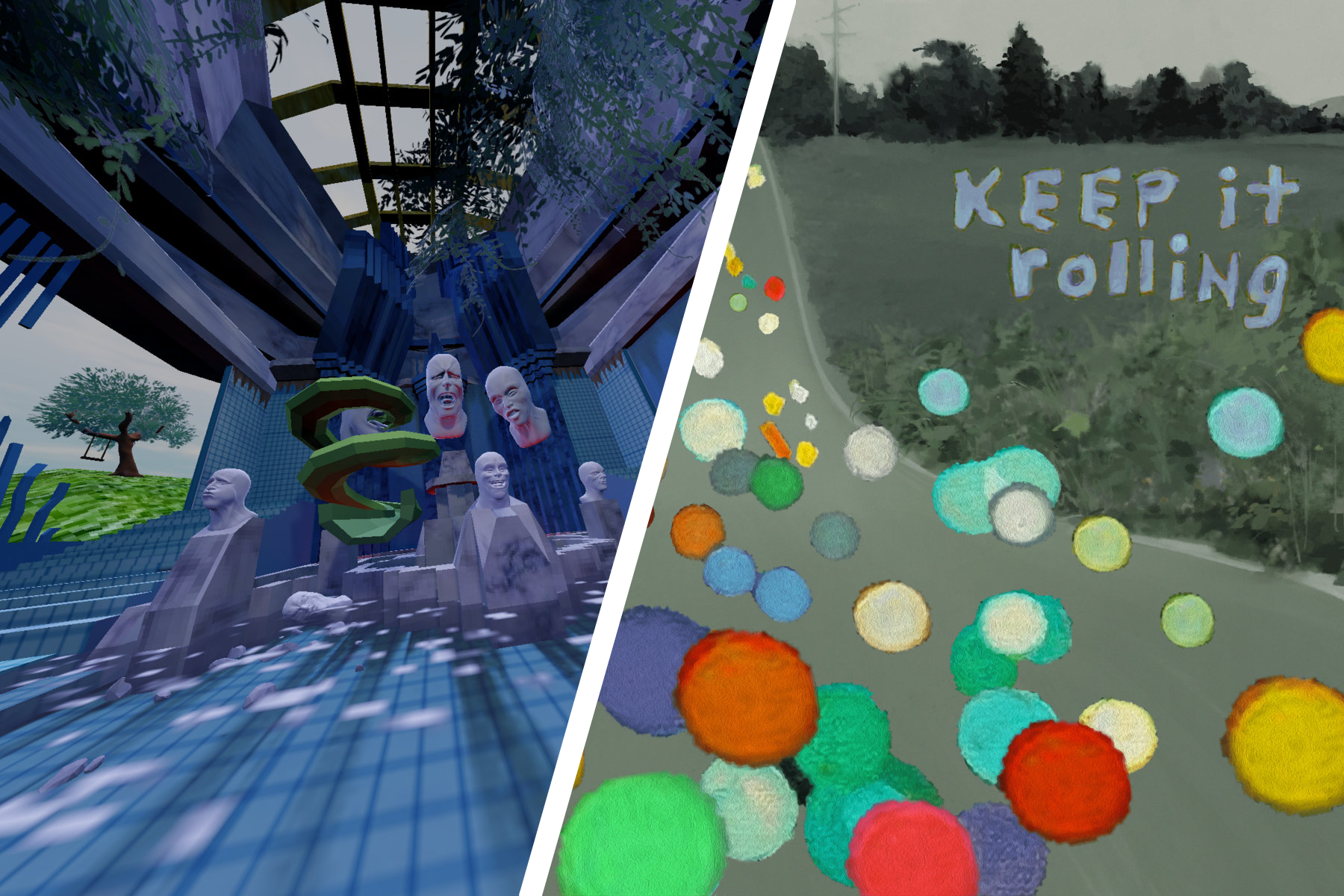
The liner notes for Jim Nopédie’s Another Childhood describe the album as a rejection of “nostalgia culture’s halcyon depiction of childhood, and retro video gaming, in favour of something more intriguing, more eerily undefined.” I think that’s an intriguing take on the subject. For some people I know, a video game played as a child is a symbol of something pure; a project that imparts a personal influence that may stay with the player for ages - an impression passed from old to young.
But recent internet culture has taken interest in the prospect of that system’s corruption. As early as 2019, communities such as 4chan’s /v/ board have worked to create folkcanon that corrupts this norm with creepypastas such as “The Wario Apparition” - narratives that warn of spirits lurking within forgotten games. By becoming active within the players’ subconscious they gain the ability to manifest in our reality. Considering the inherently interactive nature of the medium at play, it is important to note the player’s involvement in this system as a witness. Until these hidden facets of a game come to light through active discovery, they are just those - folktales. They hold no power until the player chooses to involve themselves.
Another Childhood is not based on what I’ve just described, exactly, but it is perhaps useful to look at the work through this lens of “corruption through interaction”. Each of the album’s tracks bear titles drawn from popular gaming legends, including the Seventeenth Colossus and Ocarina of Time’s infamous Temple of Light. Some truly exist, but few are deliberately crafted mysteries from the developers. The handful that are stem from glitches and the ones that aren’t were intended as jokes but confused or disturbed the children who saw them.
I think these secrets - these cryptids - carry a negative association because they threaten to break down the fundamentals of each world they are constructed around. Pokemon are not meant to cry in agony upon their encounter. You should not wake up with black pools replacing your vacant eyes and mouth. And make no mistake - the world in each of these games is, and until recently, have always been constructs. Social developments such as “game personalization” have been interesting to observe precisely because of advancements that ensure no stone is left unturned. Abilities once coveted by developers, including Dolphin’s freecam, demonstrate just how thin the veil sustaining our disbelief actually is. The line begins to blur between audience and maestro - previously, the player was a voluntary actor upon an artificial stage. Once prefabricated skies and camera angles are taken away, the hollow and vapid side of the creation is revealed. There never was anything behind that mountain, or behind that locked door. Why should there be?
This is what songs such as Reviving Aerith strike at. Hell Valley Sky Trees is melancholic because it represents something that was once unknowable, untouchable. But by the time we had the ability to fly beyond that horizon and meet the creatures we dreamed of confronting face to face, there was never any achievement to be gained. And in my eyes, that’s less satisfying than accepting the fact that in a game like Final Fantasy 7 there never was any way to bring my companion back from death, no absolution to strive toward, because that’s a process that relishes in straining this power dynamic between creator and player. Aerith is still sad - debatably the darkest on the album. We hear distant vocal samples and bell chimes. Nopédie describes this piece as “a transition between death and life”, but it also functions just as clearly as a maturation, a way of encapsulating all the discomfort between the phases of growing through childhood and into a jaded adult, sobered by the knowledge that childhood escapism itself was a construct.
That was a year and a half ago. Nopédie’s newest album, Keep It Rolling, feels like an attempt to tear down everything Another Childhood represented, and even if that prospect isn’t to everyone’s taste, I really do think it’s the best approach a follow-up could have taken. Each track maintains Jim’s signature array of eclectic samples and modulations, but they’re arranged within a package that feels light on the details. The endeavor is much more personal, and in turn more liberating and minimal. Like the previous album, Keep It Rolling shares an odd premise; not for its philosophy, but for its dichotomy as a successor to Childhood. This is a composer known for their brand sculpted around gaming lore choosing to dispose of what brought them into the limelight. It’s clear from the very first track that is a Jim Nopédie album - not a gaming folkcanon album, or anything else. And that’s a bold quality brought to these tracks I really value.
Rolling’s notes indicate that this shift from a concept album to something less defined carried with it a set of structural goals that serve to set it apart from Nopédie’s previous work. If Childhood was evocative, this album is the opposite. It grounds and centers the listener.
“My rule for Keep It Rolling was that every sound has to be as ‘neutral’ as possible—lots of basic sine waves and square waves, lots of unprocessed piano, not a lot of reverb or atmosphere—so the music doesn’t really evoke another place. It just settles you into whatever place you’re in when you’re listening.”
- Jim
Tracks like rube goldberg are fantastic. Clicks and whirs combine to form a kinetic flow of energy. It’s not a complex message to grasp - it’s all in the name. There’s beauty in brevity. Keep it modular, keep it moving.
That's a message that needs to be heard now, more than ever before. After all, if our past lacks objective, and the future seems sordid, what's left to latch onto? Keep It Rolling posits that it's the "little things" and I think there's beauty in that. Death, to life. Child, to adult, to child again.